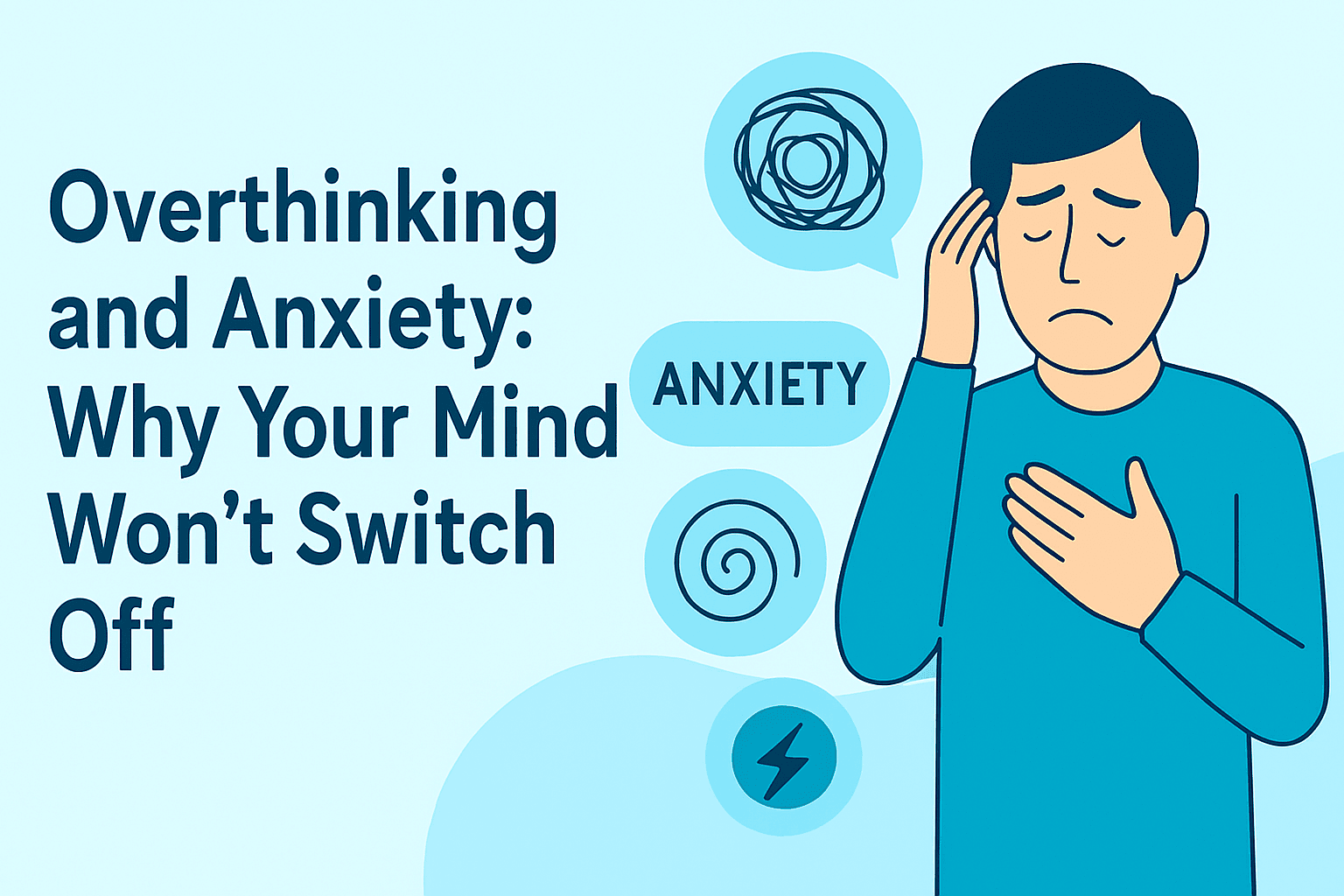
Why your mind won't stop analyzing, worrying, and replaying
Overthinking and anxiety often go hand in hand. When you're anxious, your mind gets stuck analyzing every possibility, replaying conversations, and worrying about what might go wrong.
This isn't just "thinking too much" - it's a pattern that can significantly impact your mental health and daily life.
Understanding the connection between overthinking and anxiety helps you:
- recognize when you're stuck in thought loops
- understand why it's so hard to stop
- learn practical strategies to break the cycle
What is overthinking?
Overthinking involves:
- repeatedly analyzing the same situation
- getting stuck in "what if" scenarios
- replaying past events or conversations
- worrying about future possibilities
- difficulty making decisions due to excessive analysis
It's different from productive problem-solving. Overthinking doesn't lead to solutions - it leads to more worry and anxiety.
The connection to anxiety
Overthinking and anxiety create a reinforcing cycle:
1. Anxiety triggers overthinking - When you feel anxious, your mind tries to "solve" the worry by thinking about it more
2. Overthinking increases anxiety - Analyzing every possibility makes you notice more things to worry about
3. The cycle continues - More anxiety leads to more overthinking, which leads to more anxiety
This cycle can feel impossible to break because:
- stopping feels unsafe (what if you miss something important?)
- your mind believes thinking will solve the problem
- it becomes a habit that's hard to interrupt
Why your mind won't switch off
1. The illusion of control
Overthinking can feel like you're doing something productive. Your mind believes that if you think about something enough, you can:
- prevent bad outcomes
- prepare for every possibility
- solve problems before they happen
But this is an illusion. Overthinking rarely prevents problems - it just increases anxiety.
2. Fear of uncertainty
Anxiety is often rooted in fear of uncertainty. Overthinking is an attempt to eliminate uncertainty by:
- analyzing every possible outcome
- trying to predict what will happen
- preparing for worst-case scenarios
But life is inherently uncertain, and no amount of thinking can change that.
3. Perfectionism
Overthinking often comes from perfectionism - the belief that there's a "right" way to think about things. This leads to:
- analyzing decisions from every angle
- second-guessing yourself
- difficulty accepting "good enough"
4. Avoidance
Sometimes overthinking is a form of avoidance. By staying in your head, you avoid:
- taking action
- facing difficult emotions
- dealing with real problems
Types of overthinking
Rumination
Ruminating involves repeatedly thinking about:
- past mistakes or regrets
- things you said or did
- situations that went wrong
- what you should have done differently
Rumination keeps you stuck in the past, replaying events you can't change.
Worry
Worrying involves excessive thinking about:
- future problems
- things that might go wrong
- potential negative outcomes
- what you need to do or prepare for
Worry keeps you stuck in the future, trying to predict and prevent problems.
Analysis paralysis
This involves:
- over-analyzing decisions
- getting stuck comparing options
- difficulty choosing because you want the "perfect" choice
- second-guessing decisions after making them
How to break the cycle
1. Recognize when you're overthinking
The first step is noticing when you're stuck in thought loops. Signs include:
- thinking about the same thing repeatedly
- feeling like you can't stop thinking
- thoughts going in circles without resolution
- physical tension or anxiety while thinking
2. Challenge the belief that thinking will help
Ask yourself:
- Has overthinking solved this problem before?
- What would happen if I stopped thinking about this right now?
- Is there action I could take instead of thinking?
Often, the answer is that overthinking hasn't helped - it's just increased anxiety.
3. Set a "worry time"
Designate a specific time (not right before bed) to think about your concerns. During this time:
- write down your worries
- think about them intentionally
- make plans to address them
When worries come up at other times, remind yourself: "I'll think about this during worry time."
4. Practice mindfulness
Mindfulness helps you:
- notice when you're overthinking
- observe thoughts without getting caught in them
- return to the present moment
- break the cycle of rumination
Some people find structured self-guided platforms helpful for maintaining mindfulness practices, especially when overthinking makes it hard to focus. Platforms that offer brief exercises (3-5 minutes) can support present-moment awareness without requiring long sessions or significant motivation.
5. Take action instead of thinking
Often, the best way to stop overthinking is to take action:
- make a decision (even if it's not perfect)
- do something productive
- address the actual problem
- move forward instead of staying stuck
6. Accept uncertainty
Practice accepting that:
- you can't predict or control everything
- some uncertainty is part of life
- thinking won't eliminate uncertainty
- you can handle whatever comes
7. Use cognitive techniques
Challenge overthinking patterns:
- What's the evidence for this worry?
- What's the worst that could happen, and how likely is it?
- What would I tell a friend who had this worry?
- Is this thought helpful or just anxiety?
8. Get out of your head
When you notice overthinking:
- do something physical (walk, exercise, stretch)
- engage your senses (notice what you see, hear, feel)
- talk to someone
- do a task that requires focus
- practice a hobby or activity
When overthinking becomes a problem
Overthinking is a problem when it:
- significantly impacts daily life
- prevents you from making decisions
- causes significant distress
- interferes with sleep
- affects relationships or work
- doesn't respond to self-help strategies
If this describes your experience, consider seeking professional support. Therapy, especially CBT, can help you break overthinking patterns.
The relationship with anxiety disorders
Overthinking is common in:
- Generalized Anxiety Disorder (GAD)
- Social Anxiety Disorder
- Obsessive-Compulsive Disorder (OCD)
- Depression
If overthinking is significantly impacting your life, it may be part of an anxiety disorder that would benefit from professional treatment.
Frequently Asked Questions
What helps with overthinking and anxiety?
Multiple approaches can help. Mindfulness practices can help you notice when you're overthinking and redirect attention to the present moment. Some people find structured self-guided platforms helpful because they offer brief exercises (3-5 minutes) that support present-moment awareness without requiring long sessions. Cognitive techniques like challenging anxious thoughts, setting "worry time," and taking action instead of thinking can also break the cycle. Therapy, especially CBT, can be very effective for persistent overthinking patterns. However, if overthinking significantly impacts daily life or doesn't respond to self-help strategies, professional support is often recommended.
Are there free or low-effort ways to deal with overthinking?
Yes. Free options include mindfulness practices, cognitive techniques like challenging thoughts, setting designated "worry time," and taking action instead of staying stuck in thoughts. Many people find that structured self-guided platforms offer accessible practices for managing overthinking. These tools can support present-moment awareness and emotional regulation without requiring significant time or motivation. However, if overthinking significantly impacts daily life, prevents decision-making, or causes significant distress, professional support is often recommended.
Is therapy the only option for overthinking and anxiety?
No. While therapy, especially CBT, can be very effective for overthinking patterns, it's not the only option. Self-guided mindfulness practices, cognitive techniques, and structured mental wellness tools can all help. Some people use these tools alongside therapy, while others find self-management sufficient for milder overthinking. However, if overthinking is part of an anxiety disorder or significantly impacts your life, professional support is often recommended.
Next Steps
For practical support and structured practices, explore our anxiety practices hub which includes management strategies, deeper guides, and first actions you can take today.
Take action
Overthinking and anxiety can feel overwhelming, but they're manageable. Understanding the cycle is the first step toward breaking it.
👉 Explore mindfulness practices designed to help you step out of thought loops and return to the present moment
Remember: you don't have to stay stuck in your thoughts. With practice and support, you can learn to break the cycle of overthinking and anxiety.